In short
A cloth drawstring bag with your logo costs little, and your customer can keep it for years: I still have the cotton ones from my Velasca shoes. An Instagram post gets half of its engagement in about 18 hours. Nobody has measured what the bag brings back, but the price drops with quantity: with screen printing, 1,000 pieces can take you below €1 per bag.
In this article you'll find the Velasca case, what 11 other shoe brands do, who can copy the idea, and how to choose material, fabric weight, closure and print.
The story
The cotton bag you never threw away
The bags from my Velasca shoes have been in use for years.
A useful object stays in circulation long after the purchase.
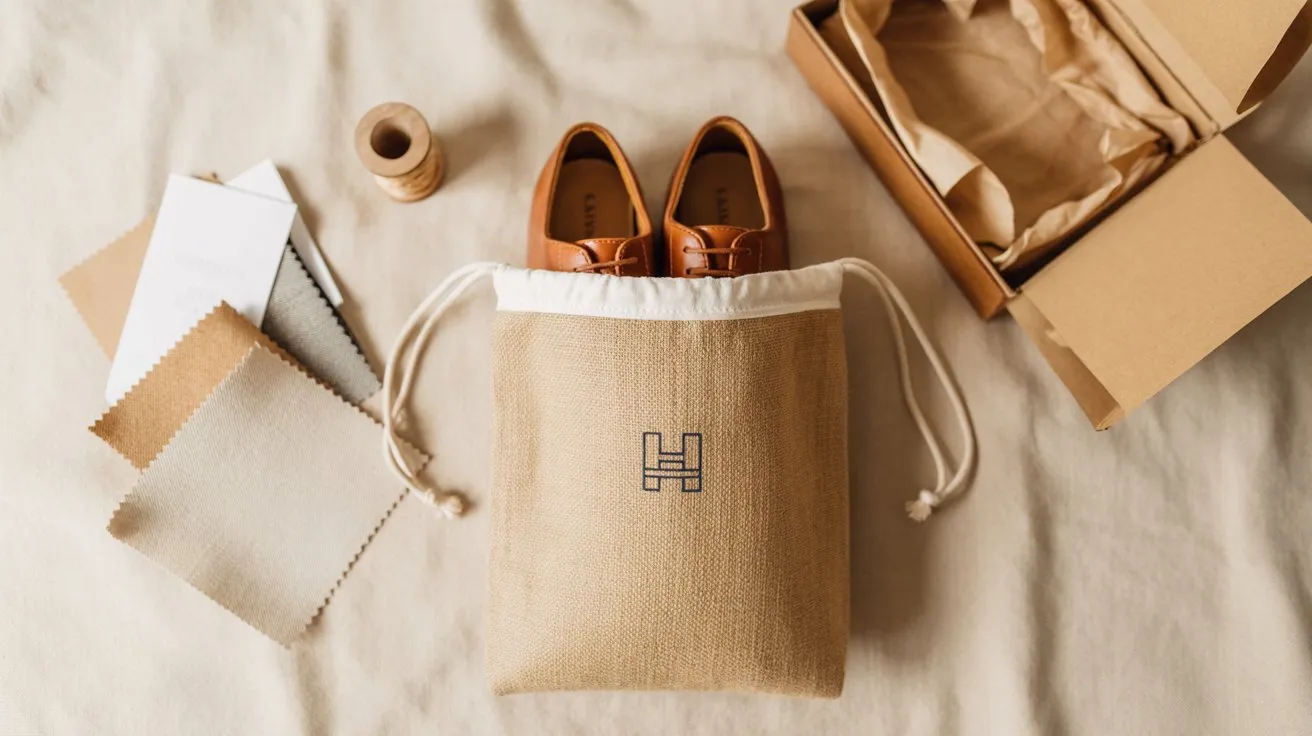
I've bought shoes from Velasca several times. The packaging is always the same: a raw cardboard box with the logo pressed into it, and inside, the shoes wrapped in two natural cotton drawstring bags with the Velasca logo printed on them. I've been using them for years when I travel. The shoes fit perfectly, they don't dirty the clothes in my suitcase, and every time I take them out I think: these are Velasca shoes.
I've never thrown them away. It never crossed my mind.
An Instagram post gets half of its engagement in about 18 hours. That bag is still in my backpack. To be honest, I've used them for other things too, because they're really practical.
That's the premise of everything that follows: a mass-produced piece of fabric, which at high volumes can cost less than a euro, can do marketing for years.
The Velasca case: when the packaging stays in the customer's hands
Velasca was born in Milan in 2013, founded by Enrico Casati and Jacopo Sebastio with a simple idea: handmade Italian shoes, produced in the Marche region and sold directly to customers with no middlemen. Today, according to Il Sole 24 Ore (September 2026), it has 28 stores and revenue of about €30 million.
The box is raw-looking cardboard and the shoes sit in two cloth bags with the brand on them, as Nidea's case study and The Monkey's review both report. We found no statement from Velasca on the role of the bags: reading them as marketing is my interpretation as a customer.
Case study
Velasca
The bag stays in use for years. A post gets half of its engagement in about 18 hours.
2
cloth bags per pair
The shoes arrive in two cloth bags with the Velasca brand on them. The customer can reuse them in a suitcase or a wardrobe, long after opening the box.
Source: Company data: Il Sole 24 Ore 2026 · Bags: Nidea, The Monkey · Review: Trustpilot
Some customers notice. A Trustpilot review from August 2026 describes the unboxing as rustic and elegant, with travel bags for the shoes. It's a single opinion, but it describes exactly the use we're talking about.
The industry: what other brands do
Velasca didn't invent the bag: it shows up at every level of the shoe market. We only kept brands with a source you can check. Where the source doesn't state the material, we say so.
| Brand | Material | Segment | What we found | Source |
|---|---|---|---|---|
| Velasca (IT) | Cloth | Premium DTC | Two bags with the brand on them | Nidea, The Monkey |
| Church's (UK) | Not stated | Luxury | The website says to store shoes in their dust bags | Church's website |
| Crockett & Jones (UK) | Not stated | Luxury | Sells bags against dust, scratches and light | Crockett & Jones website |
| Edward Green (UK) | Not stated | Luxury | Shoes sold with dust bags for travel | Mr Porter |
| Stefano Bemer (IT) | Recycled materials | Bespoke | Dust bags made with Floconcept | Stefano Bemer website |
| Bontoni (IT) | Not stated | Artisan luxury | Advises storing shoes in the bags | Bontoni website |
| Gucci (IT) | Regenerated cotton and recycled polyester | High fashion | Refers to dust bags in general, 2020 | The Impression |
| Carmina (ES) | Red cotton flannel | Artisan luxury | Refers to a special series, 2019 | Dappered |
| Grant Stone (USA) | Thick, soft cotton | Mid to high range | Bags also sold separately, in pairs | Grant Stone website |
| Meermin (ES) | Similar to cotton flannel | Affordable | One single bag for both shoes | Dappered |
| Scarosso (IT) | Not stated | DTC | The product page mentions a protective bag | Listing on Lyst |
| Shoepassion (DE) | Not stated | DTC | Bags included, careful packaging | Parisian Gentleman |
Sources confirm that a bag is there far more often than they confirm its material or logo. The number varies too: on the pair reviewed by Dappered, Meermin included one, Velasca two. This data comes from websites, reviews and product pages from different years, and it can change from model to model.
The return
What it costs and what we know about the return
As with any promotional item, the price depends on quantity.
The more you order, the less you pay: with screen printing, 1,000 pieces can go below €1. Nobody has measured what these bags bring back.
What Velasca pays for its bags isn't public. The rule of every promotional item still applies: the price depends on quantity, and the more you buy, the less you pay. With screen printing, 1,000 pieces can take you below €1 per bag. On small quantities, the cost per piece is much higher.
Do the maths per pair, because there are two bags, and on your own quantity. With MerchROI, which includes the drawstring bag among its items, you can estimate contacts and cost per contact for your case.
On the return, though, there's no number: we found no public analysis of these bags. Packaging research points in a direction. In a study of 77 consumers published in Packaging Technology and Science (2016), after opening the package, willingness to pay rose for 57% of participants, stayed the same for 29% and dropped for 14%. It covers the packaging of other products, so treat it as a clue.
Who can do it
Who can copy this model
This works for anyone who ships a physical product.
You need an object the customer has a reason to keep and reuse.
This model isn't only for shoes. It works for any brand that delivers a physical product: the bag, material and format change, the mechanism stays the same.
Who can use this model
5 settings with different logic: find yours
Small runs
Every order ships with a cotton canvas tote with the logo on it. The customer takes it to the gym, the supermarket, around town, and the logo goes out on the street with them.
HR budget
The welcome kit arrives in a cotton pouch with the logo. The other items disappear, the pouch can stay: it turns up in meetings and on business trips.
Local branding
Linen bags for the best products. Whoever buys an aged cheese or a fine olive oil gets packaging as carefully made as the product, then reuses it and takes the shop's logo to the market and to their mother-in-law's.
First run
The bag with the logo becomes the packaging of the first order, without being one more item. Fans can show it in their unboxing and reuse it in videos. For the rest of the launch, there's the merch guide for creators.
DTC differentiator
On competitors' product pages the bag comes up often, from luxury to DTC. Including one is the minimum. Doing it well is what sets you apart.
How to order
How to choose and order: the 4 settings that matter
Start with the material: fabric weight and print follow from there.
Before a volume order, ask for a sample with the print applied.
The material guides the fabric weight, and together they guide the printing technique. You'll find all the details on techniques in our guide to screen printing, DTG and DTF (in Italian).
How to choose the right product
4 settings · the marked option is a good starting point
Material
- Cotton canvasversatile, washableRecommended
- Natural juterustic, handcrafted
- Natural cottonsoft, premium
- Linen / ramienatural, fine
Fabric weight
- 100–120 g/m²light, travel
- 130–160 g/m²balancedRecommended
- 180–220 g/m²structured, holds embroidery
Closure
- Drawstringpractical, premiumRecommended
- Velcrosecure, less elegant
- Zipmost functional
Customisation
- 1-colour screen printingpays off from about 30 piecesRecommended
- DTG (digital print)multicolour, best on 100% cotton
- Embroiderystable from 180 g/m²
- DTF (film)from 1 piece, you can feel it
The higher the fabric weight, the better the bag holds its shape. A 120 g/m² bag is light and creases more easily, a 180 g/m² one has more body. For shoes and valuable products, my advice is to start from 130 g/m²: that's a judgement call, not a standard. Below 150 g/m² embroidery tends to pucker, between 180 and 220 it's stable.
A word of caution on wording: if you write "sustainable" on the bag, remember that in Italy, since 27 September 2026, generic environmental claims are banned unless proven (Legislative Decree 30/2026). We cover this in the guide to textile certifications (in Italian).
The 3 most common mistakes when choosing
Easy to avoid if you know where to look
A bag too small for the product.
The bag should hold the product comfortably. A shoe forced into a tight bag looks careless. Measure the real product, with any extra protection, before you order.
Not testing the print on the specific fabric.
A logo that's sharp on paper can come out blurry on raw jute or smudged on untreated canvas. Before a volume order, ask for a physical sample with the print applied, not a digital image, and ask upfront if you'll pay for it.
Choosing the lowest fabric weight to save money.
A thin bag creases and loses its shape: the opposite message of a quality product. Get a quote for two fabric weights and see how much the price per piece really changes.
Sources
Frequently asked questions
Can cotton drawstring bags be washed?
Usually yes, but always follow your supplier's instructions. Ask your printer how well the print holds up in the wash, not just the fabric.
At what quantity does the cost drop below €1?
It depends on material, print and supplier. With screen printing, 1,000 pieces can take you below €1 per bag. The price always drops with quantity: ask for a quote on your numbers.
Jute or cotton canvas: which is the better choice?
It depends on your brand's character. Jute says rustic and handcrafted. Cotton canvas is more neutral, softer and better suited to delicate garments in a suitcase. For an urban or premium brand, canvas is often the more versatile choice. For a handcrafted story, jute fits better.
Can the bag replace the box altogether?
For shoes with rigid soles, fragile items or padded garments, you still need the box: the bag is secondary packaging. For soft products like socks, scarves, belts and textile accessories, it can become the only packaging and reduce shipping volume.