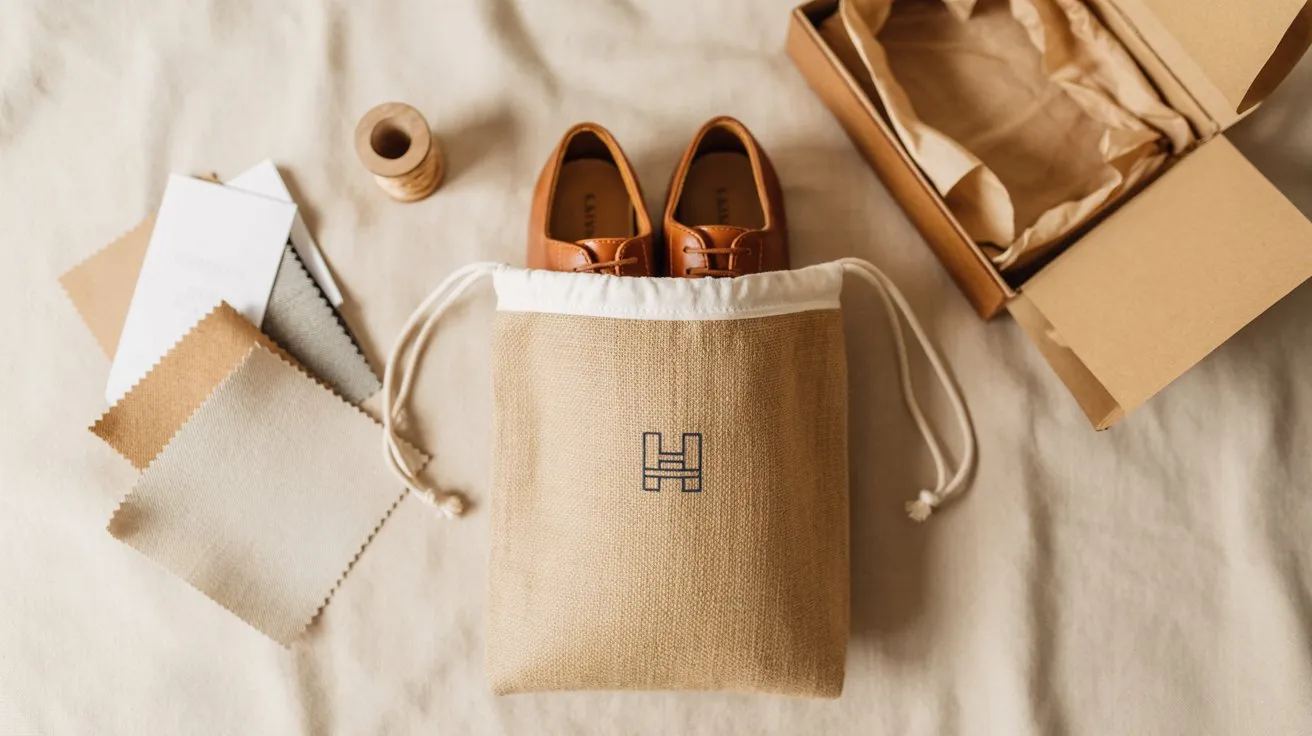
The jute bag you never threw away
I've bought shoes from Velasca multiple times. Every time the packaging is the same: a raw cardboard box with embossed logo, and inside the shoes wrapped in two jute drawstring bags with the Velasca logo printed on them. I've been using them when I travel for years — the shoes fit perfectly, they don't dirty clothes in the suitcase, and every time I pull them out I think: these shoes are Velasca.
I never threw them away. I never even thought about it.
A Velasca Instagram post lasts 48 hours in the feed before disappearing from the algorithm. That cotton bag is still in my backpack. I have to be honest, I've used it for other purposes too, because they're really practical.
This is the premise of everything that follows: a textile object that costs less than a euro, mass-produced, can do marketing for years. It's not romanticism — it's economics.
Best practice
The cost/exposure ratio of drawstring bags has no comparison in physical marketing.
The principle in one data point: A branded cotton bag at €0.54 (10,000+ unit volume) is used on average for 3–5 years. An Instagram post with the same budget is seen for 24–48 hours. The cost/exposure ratio is incomparable.
The Velasca case: how a DTC brand transformed packaging into brand equity
Velasca was founded in 2013 in Milan by Enrico Casati and Jacopo Sebastio with a simple idea: artisanal Made in Italy shoes, produced in Le Marche, sold directly online without intermediaries. The model works: in 2024 turnover exceeds €23 million, with 18 boutiques worldwide and 60% of sales from the digital channel.
Packaging has been integral to the strategy from the beginning. The box is raw uncoated cardboard with embossed logo — a choice consistent with the brand's artisanal aesthetic. Inside, shoes are wrapped in two branded jute/cotton drawstring bags. It's not a detail: it's a physical narrative element that customers take home, on trips, to their wardrobes.
Case Study
Velasca
Industry
DTC Footwear · Made in Italy
Revenue / Followers
€22.2M revenue 2024 · 18 boutiques · 60% online
Size
Mid-tier (10K–100K)
bag cost over 10,000 units
€0.54
The jute bag lasts years. An Instagram post lasts 48 hours.
Every Velasca package includes a double branded jute/cotton bag that customers actually use — in suitcases, in wardrobes, for years. On Vinted, second-hand listings with "original bag" get more visibility than those without. Secondary packaging has become an asset, not a cost item.
On Velasca's international Trustpilot profiles, two words systematically emerge in positive reviews: "fast shipping" and "beautiful packaging". This isn't coincidence — these are the two variables Velasca has direct control over between the order moment and when customers decide whether to repurchase.
The sector: what other brands do
The branded drawstring bag isn't a Velasca invention — it's an industry standard that spans all footwear market segments. What changes is the material, craftsmanship and message it conveys.
| Brand | Material | Segment | Branded | What it communicates |
|---|---|---|---|---|
| Church's (UK) | Heavy green flannel | Historic luxury | Yes — embroidered logo | Permanence, English craftsmanship |
| Edward Green (UK) | White cotton | Luxury | Yes | Purity, understated excellence |
| Crockett & Jones (UK) | Light cotton with drawstring | Luxury | Yes — logo on cord | Tradition, every detail crafted |
| Santoni (IT) | Glossy cotton / satin | Artisanal luxury | Yes | One bag per shoe — obsessive care |
| Gucci (IT) | Recycled cotton (formerly satin) | High fashion | Yes — green logo | Recognisable icon, sustainable transition |
| Tod's (IT) | Ivory cotton | Luxury | Yes | Standard white minimalist |
| Brunello Cucinelli | Grey melange cotton | Luxury | Yes | Sober elegance, no ostentation |
| Bontoni (IT) | Cotton / white towelling | Artisanal luxury | Yes | Maximum protection, craftsmanship |
| Stefano Bemer (IT) | Flannel / premium cotton | Haute couture | Yes | Florence, bespoke, nothing superfluous |
| Velasca (IT) | Jute / cotton canvas | DTC premium | Yes | Accessible craftsmanship, reusability |
| Scarosso (IT) | Bordeaux cotton canvas | DTC mid-range | Yes — contrasting logo | Minimalist approach, visible brand |
| Meermin (ES) | Light grey cotton | Entry Goodyear | Yes — basic logo | Value beyond price, honest DTC |
| Carmina (ES) | Beige cotton | Artisanal luxury | Yes | Standard for Iberian quality shoes |
| Grant Stone (USA) | Thick beige cotton (double) | Upper-mid / artisanal | Yes | Double bags = extra protection, American attention to detail |
| Thursday Boot (USA) | Cotton canvas / microfibre | Mid-range casual | Yes (some models) | Durability, not just aesthetics |
| Beckett Simonon | Black cotton with drawstring | DTC mid | Yes — leather logo | Mature DTC, premium packaging |
| Shoepassion (DE) | Light grey cotton | DTC mid | Yes | Quality packaging as differentiator |
Church's (UK)
Material
Heavy green flannel
Segment
Historic luxury
Branded
Yes — embroidered logo
What it communicates
Permanence, English craftsmanship
Edward Green (UK)
Material
White cotton
Segment
Luxury
Branded
Yes
What it communicates
Purity, understated excellence
Crockett & Jones (UK)
Material
Light cotton with drawstring
Segment
Luxury
Branded
Yes — logo on cord
What it communicates
Tradition, every detail crafted
Santoni (IT)
Material
Glossy cotton / satin
Segment
Artisanal luxury
Branded
Yes
What it communicates
One bag per shoe — obsessive care
Gucci (IT)
Material
Recycled cotton (formerly satin)
Segment
High fashion
Branded
Yes — green logo
What it communicates
Recognisable icon, sustainable transition
Tod's (IT)
Material
Ivory cotton
Segment
Luxury
Branded
Yes
What it communicates
Standard white minimalist
Brunello Cucinelli
Material
Grey melange cotton
Segment
Luxury
Branded
Yes
What it communicates
Sober elegance, no ostentation
Bontoni (IT)
Material
Cotton / white towelling
Segment
Artisanal luxury
Branded
Yes
What it communicates
Maximum protection, craftsmanship
Stefano Bemer (IT)
Material
Flannel / premium cotton
Segment
Haute couture
Branded
Yes
What it communicates
Florence, bespoke, nothing superfluous
Velasca (IT)
Material
Jute / cotton canvas
Segment
DTC premium
Branded
Yes
What it communicates
Accessible craftsmanship, reusability
Scarosso (IT)
Material
Bordeaux cotton canvas
Segment
DTC mid-range
Branded
Yes — contrasting logo
What it communicates
Minimalist approach, visible brand
Meermin (ES)
Material
Light grey cotton
Segment
Entry Goodyear
Branded
Yes — basic logo
What it communicates
Value beyond price, honest DTC
Carmina (ES)
Material
Beige cotton
Segment
Artisanal luxury
Branded
Yes
What it communicates
Standard for Iberian quality shoes
Grant Stone (USA)
Material
Thick beige cotton (double)
Segment
Upper-mid / artisanal
Branded
Yes
What it communicates
Double bags = extra protection, American attention to detail
Thursday Boot (USA)
Material
Cotton canvas / microfibre
Segment
Mid-range casual
Branded
Yes (some models)
What it communicates
Durability, not just aesthetics
Beckett Simonon
Material
Black cotton with drawstring
Segment
DTC mid
Branded
Yes — leather logo
What it communicates
Mature DTC, premium packaging
Shoepassion (DE)
Material
Light grey cotton
Segment
DTC mid
Branded
Yes
What it communicates
Quality packaging as differentiator
The table reveals a clear pattern: no quality brand — from historic luxury to accessible DTC — has eliminated the drawstring bag. It's an implicit industry standard. Its absence in this market segment would be a jarring note, not a design choice.
What differentiates brands isn't whether they include it, but how they use it: luxury focuses on premium materials (flannel, satin, Egyptian cotton) and artisanal craftsmanship; DTC focuses on functional materials (canvas, jute) and explicitly communicated practicality — "reuse it, take it travelling".
How luxury does it: 5 cases compared
Church's
Creator · Historic luxury · UK · since 1873
“The gold standard for protection. Embroidered logo, not printed. The bag is older than the modern brand — it's an institution.”
Santoni
Creator · Artisanal luxury · Marche · IT
“One bag for each individual shoe — not for the pair. Obsessive attention to detail that customers remember and talk about.”
Gucci
Creator · High fashion · Florence · IT
“The green bag is as iconic as the logo. The transition to recycled cotton happened without sacrificing visual recognition — the shape remained identical.”
Grant Stone
Creator · Upper-mid · artisanal · USA
“Double bags in thick cotton — one per shoe. Clear signal: we care enough to double the material. Customers perceive this.”
Scarosso
Creator · DTC mid-range · Made in Italy
“Same tier as Velasca, opposite approach: the deep burgundy makes the bag instantly recognisable. Two valid philosophies — discretion vs colour visibility.”
The real ROI: what it costs and what it's worth
The cost of a branded cotton bag varies as much as the order volume. The curve drops rapidly: from over €2 for small batches to under €0.60 for large volumes. At these prices, the ratio between cost and generated value is hard to match with any other physical marketing tool.
The crucial point isn't the absolute cost but the ratio between marginal cost and perceived impact. Industry studies estimate that thoughtful secondary packaging increases a product's perceived value by 15–20% at the moment of unboxing. On a €280 pair of shoes, this translates to a perceived delta of €42–56 — against a bag that costs €0.54.
Who can replicate this scheme
The drawstring bag model isn't exclusive to footwear. The principle — a branded textile accessory with high useful life and low marginal cost — applies to any physical brand that delivers a product. The variable changes (bag type, material, format), the mechanism is identical.
Who can apply this scheme
5 contexts with different logics — find yours
Every shipped order includes a cotton canvas shopper with the logo. Customers use it daily — at the gym, supermarket, out and about. Additional cost: €1.20–1.80 per order. Impact: organic visibility on streets, in gyms, at universities. At 50 pieces the total spend is €60–90 — less than a one-day Instagram campaign.
How to choose and order: the 4 parameters that matter
Choosing the right bag isn't complicated, but it has variables that influence each other. Material determines optimal weight; weight determines the most suitable printing technique; printing technique determines the supplier. Starting with material is the correct path.
A note on GSM: the higher it is, the better the drawstring bag holds its shape and has physical presence. A 120 g/m² bag creases easily and communicates flimsiness (in the negative sense). A 180 g/m² bag stays open by itself, stacks neatly, has a completely different sound when touched. For shoes and premium products, don't go below 130 g/m².
The 3 most common selection mistakes
Easily avoidable errors if you know what to look for
Get the weekly customisation guide
Every week: an industry trend, a practical guide and pricing advice — straight to your inbox. Free, useful, no spam.